 |
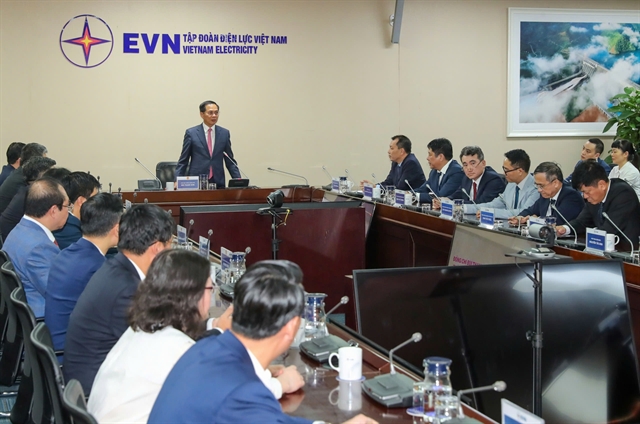
| Deputy Prime Minister Bùi Thanh Sơn delivers a speech during a working visit to EVN. — Photo courtesy of EVN |
HÀ NỘI — Deputy Prime Minister Bùi Thanh Sơn has asked Vietnam Electricity (EVN) to grow power generation by more than 15 per cent in 2026 to support the Government’s target of over 10 per cent economic expansion and meet rising electricity demand from emerging industries, such as semiconductors and artificial intelligence.
The request was made during a working visit on Monday to major State-owned energy and industrial groups, including Petrovietnam, Petrolimex, Vinachem and EVN.
Sơn said that this is the first year of implementation for the 14th National Party Congress resolution and the start of the 2026–30 development period, which sets out ambitious targets and high expectations for growth.
He said major State-owned corporations must demonstrate stronger determination, greater innovation and more effective governance to reach new heights in the next few years, particularly in strategic sectors like energy, industry and infrastructure.
In 2025, EVN’s consolidated revenue was estimated at VNĐ645.2 trillion (US$24.6 billion), up 10.3 per cent compared to 2024. Revenue of the parent company alone reached VNĐ543.8 trillion, marking an increase of 11.8 per cent year-on-year.
By the end of 2025, total installed capacity of the national power system – excluding imported electricity – reached approximately 87,600MW, an increase of around 6,400MW compared to the previous year. With this scale, Việt Nam’s power system ranks second in ASEAN in terms of installed capacity.
Renewable energy sources, including wind, solar and biomass, accounted for 24,453MW, or 27.9 per cent of total capacity. Coal-fired thermal power made up about 28,100MW, equivalent to 32.1 per cent, while hydropower reached 24,640MW, accounting for 28.1 per cent.
Over the past year, EVN has brought a number of major generation and transmission projects into operation. These include the expanded Hòa Bình Hydropower Plant, the 500kV Lào Cai–Vĩnh Yên transmission line and the power supply system comprising overhead lines and submarine cables to Côn Đảo Island. The group has also started construction on several new projects aimed at strengthening energy security and grid stability.
As for the Ninh Thuận 1 Nuclear Power Plant, for which EVN serves as the investor, negotiations on an inter-governmental agreement have recorded positive progress. Relevant parties are continuing discussions on preparatory work, with the possibility of starting several components of the project as early as 2026.
The deputy PM acknowledged and commended EVN’s efforts in ensuring the safe and reliable operation of the national power system, particularly during the recent Tết (Lunar New Year) holiday, when electricity demand typically surges and political, cultural and social events take place nationwide.
However, he said that the challenges ahead remain substantial. Rapid economic growth, accelerating industrialisation and the development of high-tech sectors will require a stable, sufficient and increasingly green power supply.
Sơn urged EVN to ensure on-schedule completion of all power generation and transmission projects for which it is the investor, while improving project management capacity and removing bottlenecks that could delay progress.
He also called on the group to promptly and effectively implement the Ninh Thuận 1 nuclear power project, gradually mastering nuclear power technology and strengthening domestic technical capacity in this field.
In addition, EVN was asked to step up cooperation with Laos, Cambodia and China in cross-border electricity trading, while promoting greater connectivity within ASEAN’s regional power grid to enhance energy security and optimise resource allocation.
The deputy PM emphasised that energy development must go hand in hand with sustainability, digital transformation and improved operational efficiency, contributing to the country’s broader goals of green growth and deeper international integration.
With rising electricity demand from new industries and continued economic restructuring, the power sector will play a pivotal role in underpinning Việt Nam’s development aspirations in the years ahead, he stressed.
Share